
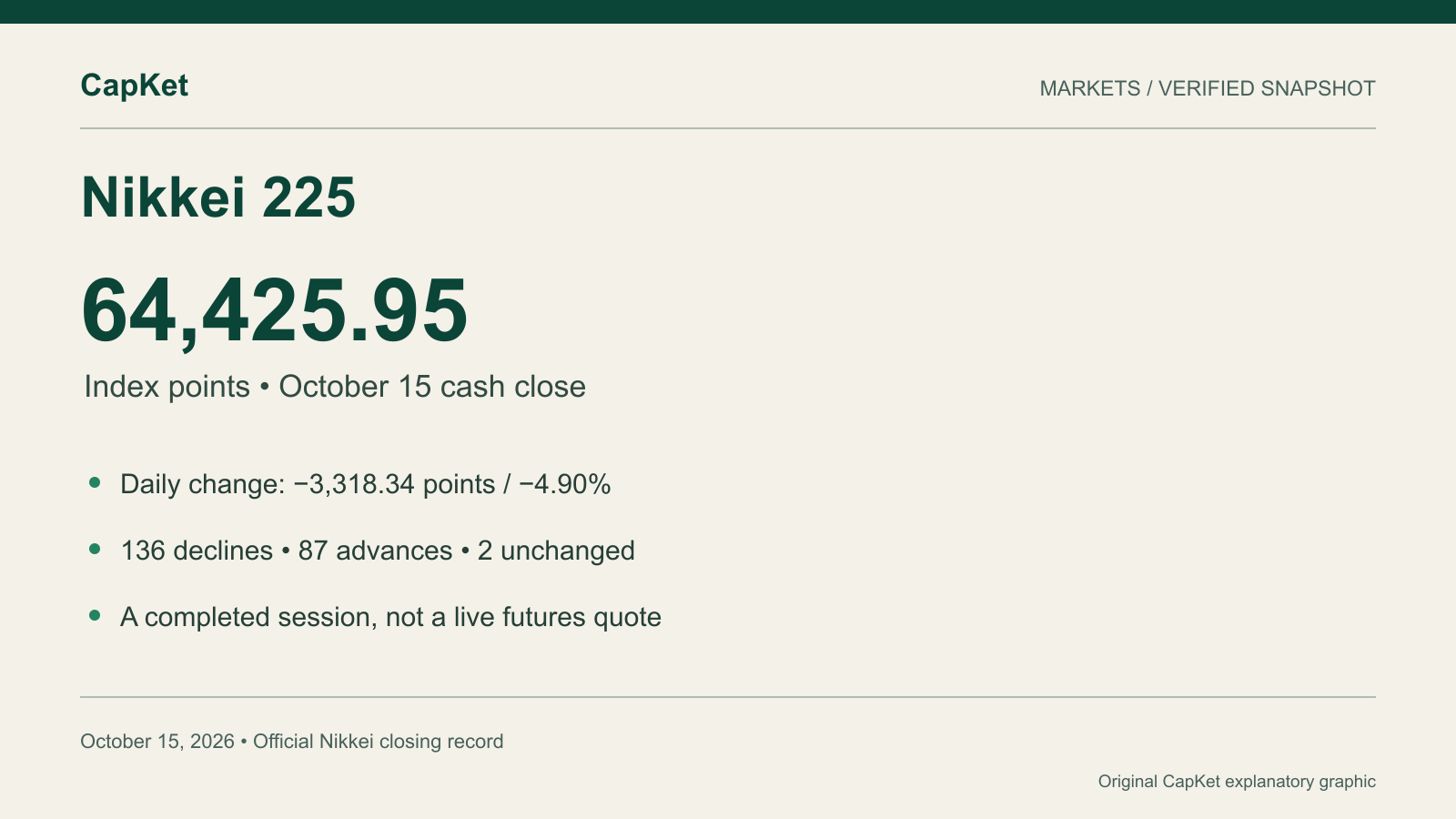
Japan’s Nikkei 225 finished October 15, 2026 at 64,425.95 points, down 3,318.34 points or 4.90%, according to the index owner’s official closing record. The daily summary also showed more falling stocks than rising ones: 136 declined, 87 advanced and two were unchanged.
This is a completed cash-market session. It is not a live Nikkei quote, a futures contract or a yen amount that an investor pays for a share. The source explicitly marks the October 15 value as the close.
The official session in numbers
| Measure | October 15, 2026 |
|---|---|
| Cash-index close | 64,425.95 points |
| Daily change | −3,318.34 points; −4.90% |
| Open | 66,880.37 points |
| Session high | 66,929.30 points |
| Session low | 64,092.74 points |
| Market breadth | 87 advances; 136 declines; 2 unchanged |
What the breadth count does—and does not—show
The breadth figures cover the benchmark’s 225 constituents. They show that declines were more widespread than advances, not that every stock lost 4.90%. Nikkei describes the benchmark as a price-weighted index of 225 stocks in the Tokyo Stock Exchange Prime Market. Its movement should therefore not be read as an equal-weight average of each stock’s percentage return.
The session’s open, high, low and close are different observations. The low was below the final close, while the opening level was above it. Those facts describe the trading range; they do not establish why investors bought or sold.
Keep market sessions separate
A dated Japanese close should not be presented as simultaneous with a later European intraday level or a US futures quote. This report has not verified a market driver, an earnings explanation for the fall or the direction of the next session.
Primary sources and observation
Nikkei’s official daily summary, dated October 15, 2026 · Nikkei index-owner homepage and closing label. Sources observed 15/10/2026 at 17:35:22 IST (12:05:22 UTC). The closing value is dated, but no separate clock time is printed beside it; none has been invented.
Related dated report: Hang Seng Index Down 1.03% in October 15 Reading; Sector Moves Differ.
Recorded source observation: . This is a source-check timestamp, not a market quote or a new article update.