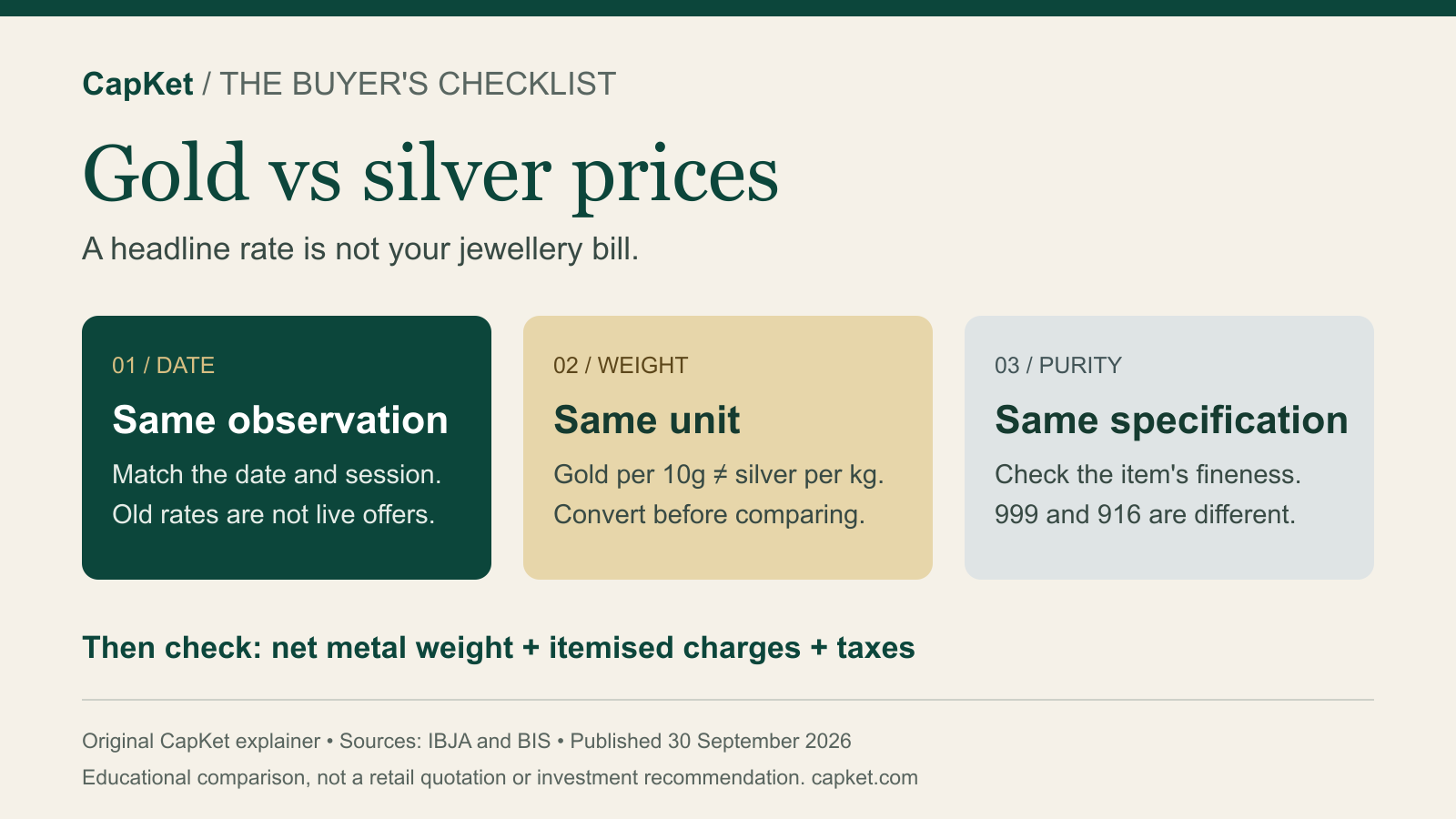
Comparing gold and silver starts with a unit check, not the size of the number in a headline. A quotation for one kilogram of silver and another for 10 grams of gold describe different quantities. Neither, by itself, tells you what a finished piece of jewellery should cost.
This explainer adds a worked comparison to CapKet’s separate September 29 gold report and silver report. The numbers below remain historical examples, not fresh September 30 rates.
First, put the quotations on one weight basis
The IBJA September 29, 2026 PM sheet gives gold 999 at ₹1,47,667 per 10 grams and silver 999 at ₹2,21,600 per kilogram. Dividing the first by 10 and the second by 1,000 produces the following comparison.
| Benchmark specification | Per gram, calculated | Per 10 grams, calculated |
|---|---|---|
| Gold 999 | ₹14,766.70 | ₹1,47,667 |
| Silver 999 | ₹221.60 | ₹2,216 |
The conversion changes the unit, not the metal’s value. It also does not tell you which metal is a better investment: a lower price per gram is not evidence of a higher future return.
Next, use the purity of the actual item
BIS identifies 22-karat gold with 916 fineness. A gold 999 benchmark therefore is not a like-for-like specification for a 22K ornament. For a purchase worksheet, ask the seller which purity-specific rate is being applied rather than silently substituting a higher-purity quotation.
For an arithmetic example, the same IBJA sheet’s gold 916 rate of ₹1,35,263 per 10 grams becomes ₹13,526.30 per gram. An illustrative item containing exactly 8 grams of that gold gives 8 × ₹13,526.30 = ₹1,08,210.40 as a benchmark-based metal component. Eight grams is a hypothetical weight, not an observed product or shop offer.
Then reconcile the final bill
IBJA states that its rates exclude GST and making charges. Do not mistake the example’s metal component for a payable total. Ask for a written breakdown identifying the metal weight, applied rate, making charges, any separately priced stones or other components, and taxes. Ask how each charge is calculated instead of assuming two sellers use the same method.
A practical comparison sheet should record five fields for each offer: observation date and time; metal and purity; net metal weight; metal-value calculation; and the itemised final amount. If any field is missing, the apparent saving is not yet a like-for-like comparison.
Purity verification is a separate check
BIS consumer guidance describes checking gold jewellery’s HUID through BIS Care and obtaining chargeable testing from recognised assaying and hallmarking centres. A purity check does not certify that a seller’s price is competitive. Equally, a low asking price does not establish purity.
Evidence checked September 30, 2026, approximately 02:21 IST (September 29, 20:51 UTC). Historical rate date: September 29 PM; the dated sheet was first verified by CapKet on September 29 at approximately 20:26 IST. BIS general guidance supports the 22K/916 correspondence. CapKet has not checked retail availability, obtained executable quotations or established a cause for price movements. No forecast is implied.