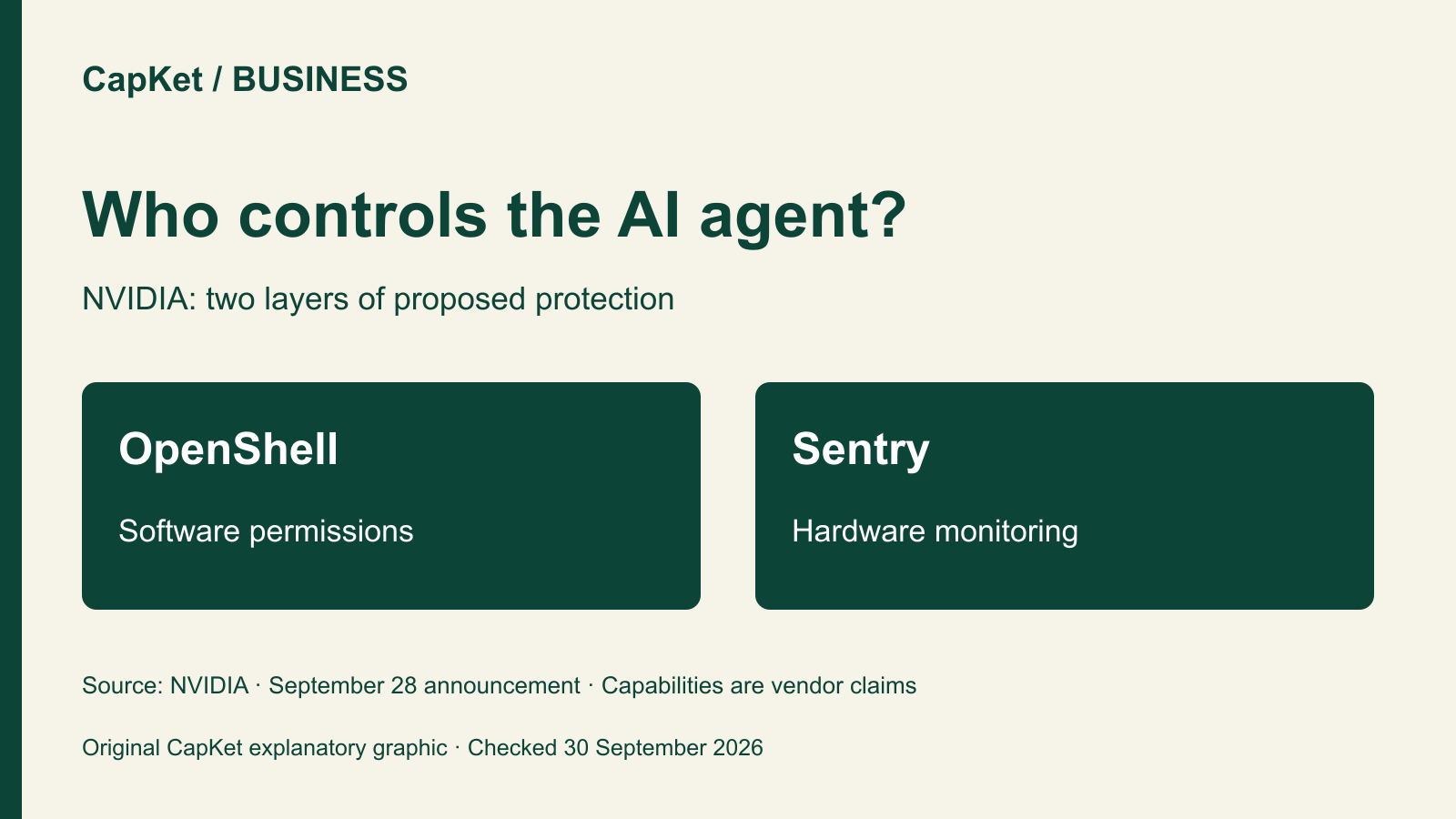
NVIDIA has introduced an AI-agent safety platform aimed at giving businesses controls outside the agents they deploy. Its September 28 announcement pairs OpenShell software with a Sentry hardware reference design. The practical distinction is between assigning an agent a task and controlling the systems it can actually use.
OpenShell vs Sentry: which part controls what?
| Component | Issuer-described role | What this report does not establish | Primary evidence |
|---|---|---|---|
| OpenShell | Software runtime boundary for tracing actions and enforcing agent policy | An independent audit of the reader’s configuration | NVIDIA announcement — software |
| Sentry | Separate watchdog on BlueField-4 DPUs; NVIDIA says it can quarantine an agent | An independently reproduced isolation speed or failure rate | NVIDIA announcement — reference system |
These are different control layers, not two names for the same product. The descriptions come from NVIDIA. CapKet has not tested the claimed protection or quarantine performance.
The company’s technical explanation describes sandboxed execution, controlled service access and credential handling outside the agent workload. In plain English, a convincing instruction from a model should not automatically become permission to read a file, access a credential or call a business service.
What a business should ask
CapKet analysis: A useful procurement discussion should start with the permissions, not the demo. Which actions require a person’s approval? Who owns the policy? Can an incident be reconstructed from the logs? What happens if the monitoring component becomes unavailable? These are evaluation questions, not findings about a particular customer’s deployment.
A product announcement is also not an independent security audit. Readers should distinguish software availability from proven effectiveness in their own environment. CapKet has not inspected customer deployments, measured the operating overhead or verified commercial savings. No revenue forecast or share-price consequence is inferred from the launch.
Evidence and next checks
The next useful evidence would be implementation documentation and reproducible results under clearly stated test conditions. For a separate enterprise-control use case, read our UiPath–BDO monitoring and testing report.
Sources checked: NVIDIA’s dated announcement and its OpenShell technical explanation, observed September 30, 2026 at 16:17 IST. Both are vendor sources. This report concerns the September 28 development, not a new launch today.
Reader clarification — 19 October 2026: Added a component-by-component source table. Vendor descriptions remain attributed claims, not evidence of independently tested security or savings. The original publication date is retained. Source recheck: (UTC); AI-assisted document review, not independent human approval.
Recorded source observation: . This is a source-check timestamp, not a market quote or a new article update.