
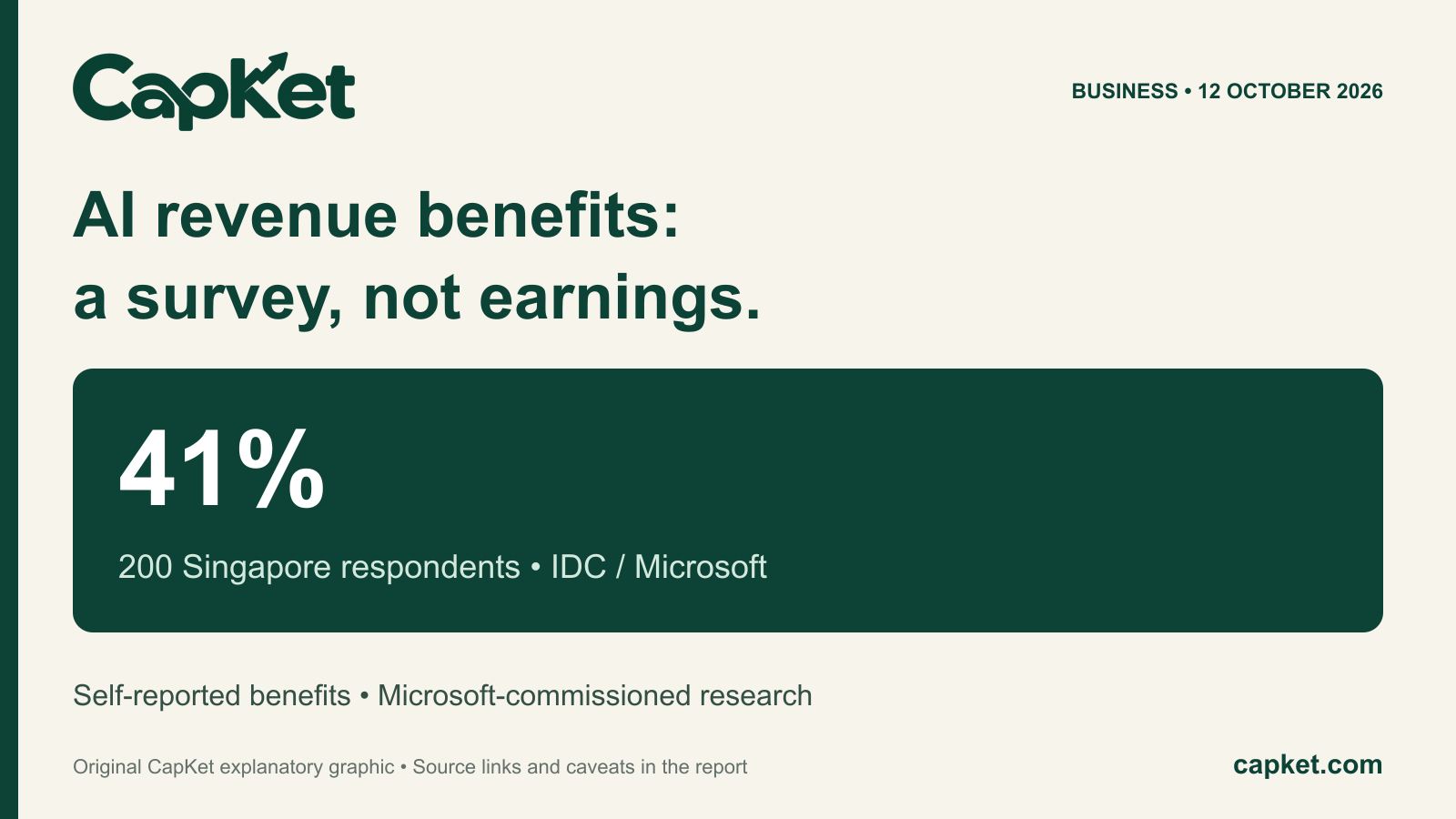
A new Singapore AI survey points to reported business benefits—but the numbers need to be read as survey answers, not corporate earnings. In findings released by Microsoft on October 12, 41% of respondents said AI was helping grow revenue or create new revenue streams.
IDC conducted the research commissioned by Microsoft. The local findings cover 200 Singapore respondents. They do not mean that 41% of every business in Singapore has independently verified AI-related revenue growth. CapKet checked the release and its accompanying official research page on October 12, 2026 at 14:56 IST.
What the Singapore findings report
| Reported measure | Singapore result |
|---|---|
| Revenue growth or new revenue streams | 41% |
| Significant or transformative outcomes | 68% |
| IDC “Frontier Firms” classification | 17% (global: 10%) |
| Middle or highest AI maturity | Nearly 73% (global: 70%) |
IDC uses “Frontier Firms” as a classification for organisations with more developed AI strategies. It is a research category, not a stock-market label or a regulatory certification. The release says its maturity framework considers spending discipline, breadth of use, agentic adoption, skills, confidence in managing risks and outcomes.
Keep the sample and sponsorship visible
The accompanying IDC infographic published by Microsoft is explicitly marked as sponsored by Microsoft. The release’s footnote references a July 2026 global survey with 5,204 respondents. That global sample and the 200-person Singapore findings are different scopes; they should not be combined into one Singapore sample.
The business outcomes quoted here are self-reported. This is not an audited statement of revenue or profit, and the published percentages do not by themselves prove that AI caused an earnings increase. CapKet has not independently audited participating organisations’ accounts or verified the representativeness of the local sample.
How to read the commercial takeaway
For someone assessing an AI project, the useful next question is how reported benefits are measured. Revenue, cost savings and profit are separate measures. A sensible comparison would state the period, implementation cost and specific outcome before presenting a return figure; this survey is not a return guarantee.
The distinction between spending commitments and realised business results also matters in CapKet’s report on NVIDIA’s research commitment. Neither a planned investment nor a positive survey response is a substitute for a company’s financial results.