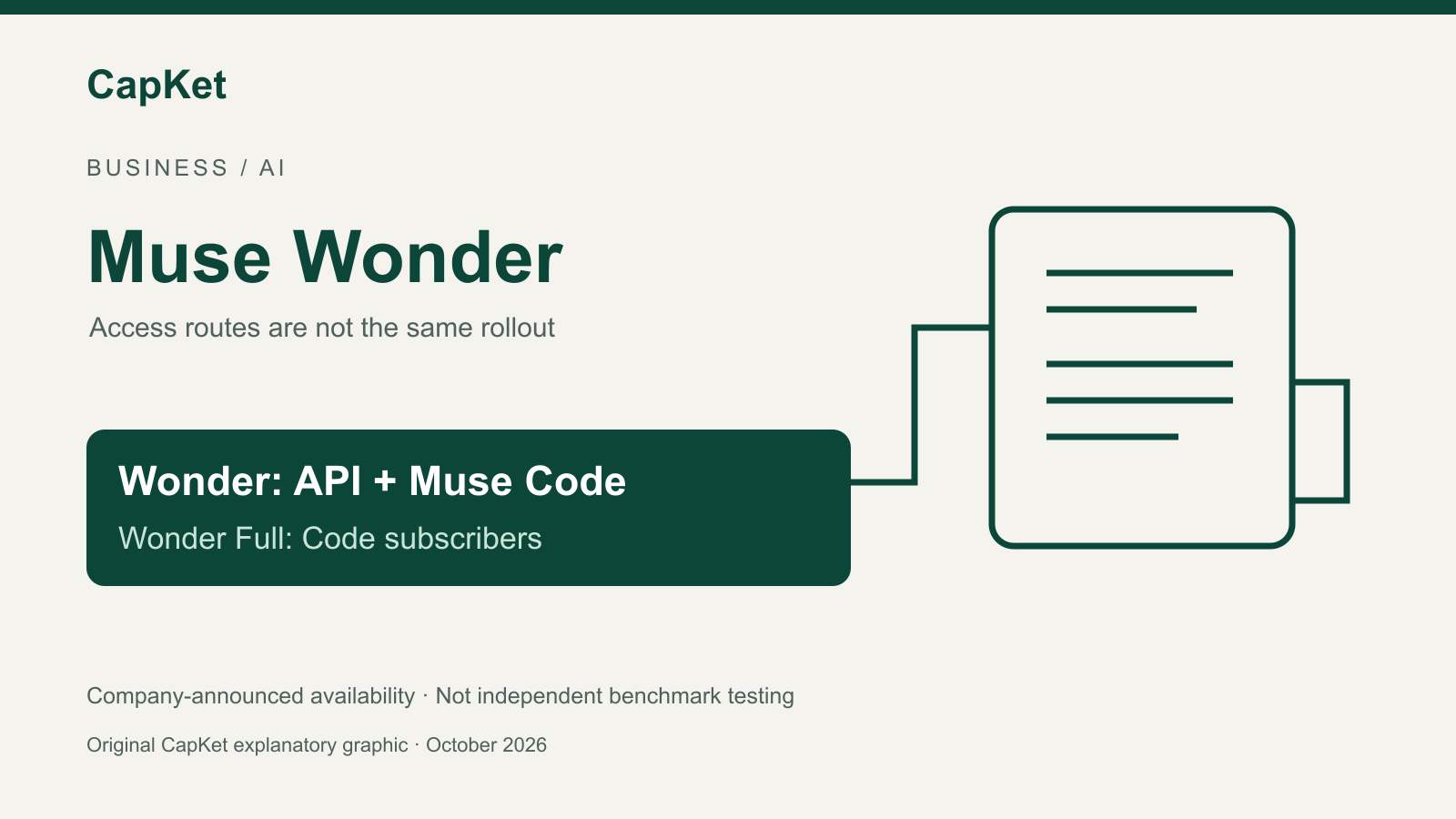
Meta announced Muse Wonder and Muse Wonder Full on October 12, 2026, adding two models to its AI-agent offering. The practical distinction is access: Meta says Muse Wonder is available through its Meta Model API and Muse Code, while Muse Wonder Full is available to Muse Code subscribers. Its announcement describes wider integration into the consumer Muse experience as a future rollout, starting with subscribers.
Which model is available where?
| Item | Verified information / limitation |
|---|---|
| Muse Wonder | Meta Model API and Muse Code, according to Meta’s October 12 announcement |
| Muse Wonder Full | Available to Muse Code subscribers, according to Meta |
| Consumer Muse rollout | Announced as coming soon, first to subscribers; not a completed universal rollout |
| Performance claims | Company-reported; CapKet has not independently benchmarked the models |
| Business impact | No revenue, profit or cost-saving outcome established by this launch |
What the agent features are intended to do
An API is a way for software to access a service; availability through it is different from a feature appearing in every consumer account. Meta’s research note describes Active Memory as retaining relevant context across conversations. It describes Active Focus as continuing work on a task, trying alternative approaches and requesting clarification or confirmation when needed.
These are the developer’s descriptions of the models, not a CapKet certification that every task will be completed accurately. Meta discusses coding and professional uses, but CapKet has not independently tested the launch, reproduced its benchmark results or established the availability of every feature in India.
Availability is not an earnings result
For businesses assessing the announcement, the immediate questions are eligibility, product terms and control over information used in a workflow. A model’s ability to handle a task does not by itself establish how much a business will earn or save. This report therefore makes no revenue forecast, investment recommendation or claim that the launch explains a share-price movement.
Likewise, a promised consumer rollout is not the same as universal access today. Check the current product documentation and the relevant subscription before relying on either model in a working process. Keep human verification for consequential outputs rather than treating vendor benchmarks as approval of a specific decision.
A separate CapKet report on Freshworks’ Torii agreement examines a different AI-spending development; it is not evidence for Meta’s performance.
Primary evidence and limits
CapKet checked Meta’s dated announcement and its research explanation on October 13, 2026. The announcement date remains October 12. Independent benchmarks, pricing comparisons and Google Trends or X trend rankings were not verified.
Recorded source observation: . This is a source-check timestamp, not a market quote or a new article update.