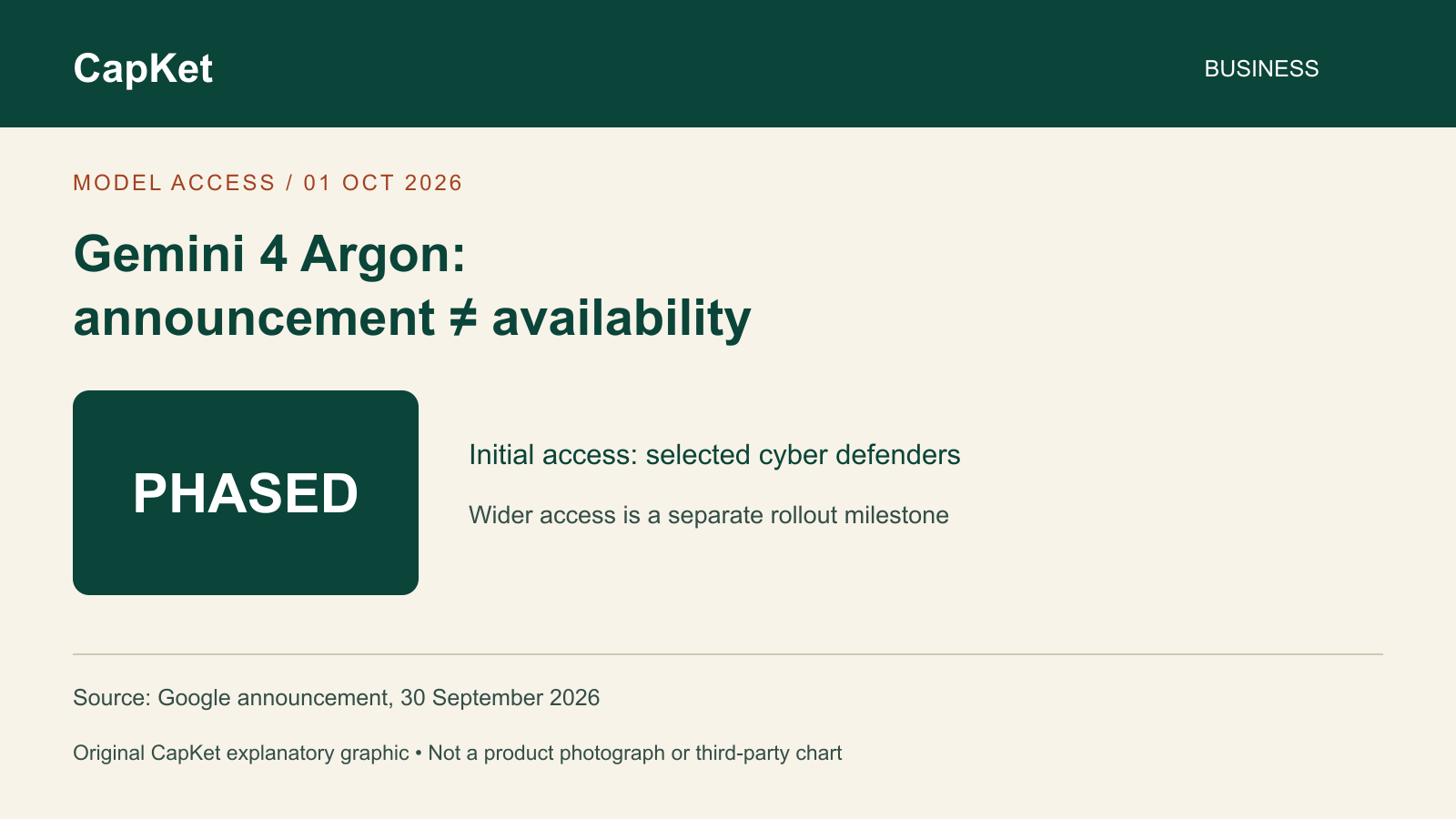
Google has announced Gemini 4 Argon, but the announcement does not mean the model is available to every business or consumer. Its September 30 release says the first rollout is to selected cyber defenders through the Fairwind programme, with wider access to follow.
Who gets access first?
Google describes a phased release and says paid API customers and Google AI Ultra subscribers will be among the first groups in the subsequent rollout. The announcement does not establish a general-access date. Its descriptions of coding, finance and other capabilities are company claims; CapKet has not independently tested them.
The published price is a starting point
Google lists introductory API prices of $2 per million input tokens and $10 per million output tokens. Its footnote gives later rates of $4 and $20 respectively. Tokens are units of text or other information processed by a model. The cited announcement does not specify when the introductory period ends.
What this means for a business buyer
CapKet analysis: Treat eligibility, workload suitability and budget approval as separate decisions. A procurement team can first establish whether it can obtain access, then design a small trial using examples of the work it actually needs completed. An attractive demonstration is not a substitute for that trial.
For budgeting, record how much input and output the trial consumes, how often a task must be repeated and how much checking the result requires. Compare the complete task cost at both price tiers. This is a suggested evaluation method, not a prediction of Argon’s cost or performance.
The same distinction applies to rollout planning: an announced capability should not be treated as an already delivered service. Our IBM finance-readiness report explains why responsibility for AI spending and readiness to deploy it are different questions.
Primary source: Google’s Gemini 4 Argon announcement, dated September 30 and checked October 1, 2026 at approximately 18:11 IST.