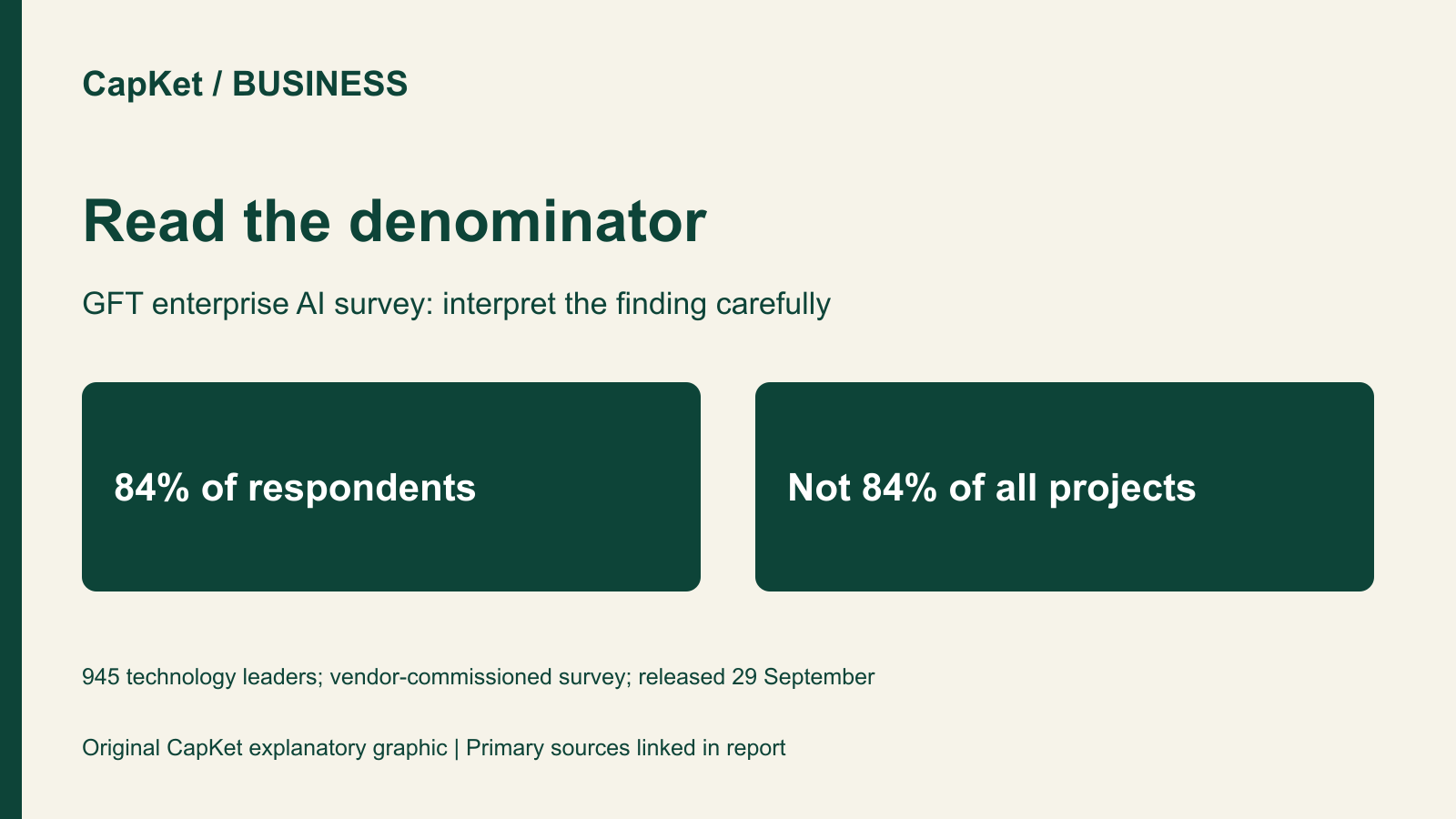
A GFT Technologies survey released September 29 reports that 84% of respondents had cancelled an AI pilot or project because of limitations in older systems. That is a finding about reported organisational experience—not a claim that 84% of all AI projects fail.
Who was asked?
Wakefield Research surveyed 945 chief information and technology officers across 19 countries at companies with at least $500 million in annual revenue. The online research ran August 11–31, 2026. GFT commissioned the study and sells technology-transformation services.
The denominator changes the story
CapKet analysis: Imagine a company that tried ten projects and cancelled one. Its technology leader could report a cancellation, even though nine projects continued. Counting leaders who experienced a cancellation therefore answers a different question from counting cancelled projects. This is an illustrative example, not a reconstruction of the survey responses.
The sample boundary matters too. A small retailer assessing its first automation tool should not assume that findings from large companies describe its own starting point. Before using a survey in a spending decision, ask which organisations it represents and whether the question measures opinion, recollection or observed outcomes.
A practical investment check
A pilot proposal can identify the source records it needs, the people allowed to use them and the test for success before approving a wider rollout. That makes the discussion specific: which missing connection or incomplete record prevents this task from working? It avoids treating a broad survey percentage as an instruction to buy a particular service.
CapKet has not reviewed respondent-level data or independently measured cancellations. For a concrete cost-comparison example, read our NTT DOCOMO BUSINESS cloud report.
Primary source record: Original announcement and issuer’s downloadable release. Checked September 30, 2026, around 18:23 IST. The linked issuer material supports the attributed facts; CapKet’s explanatory examples are identified above.