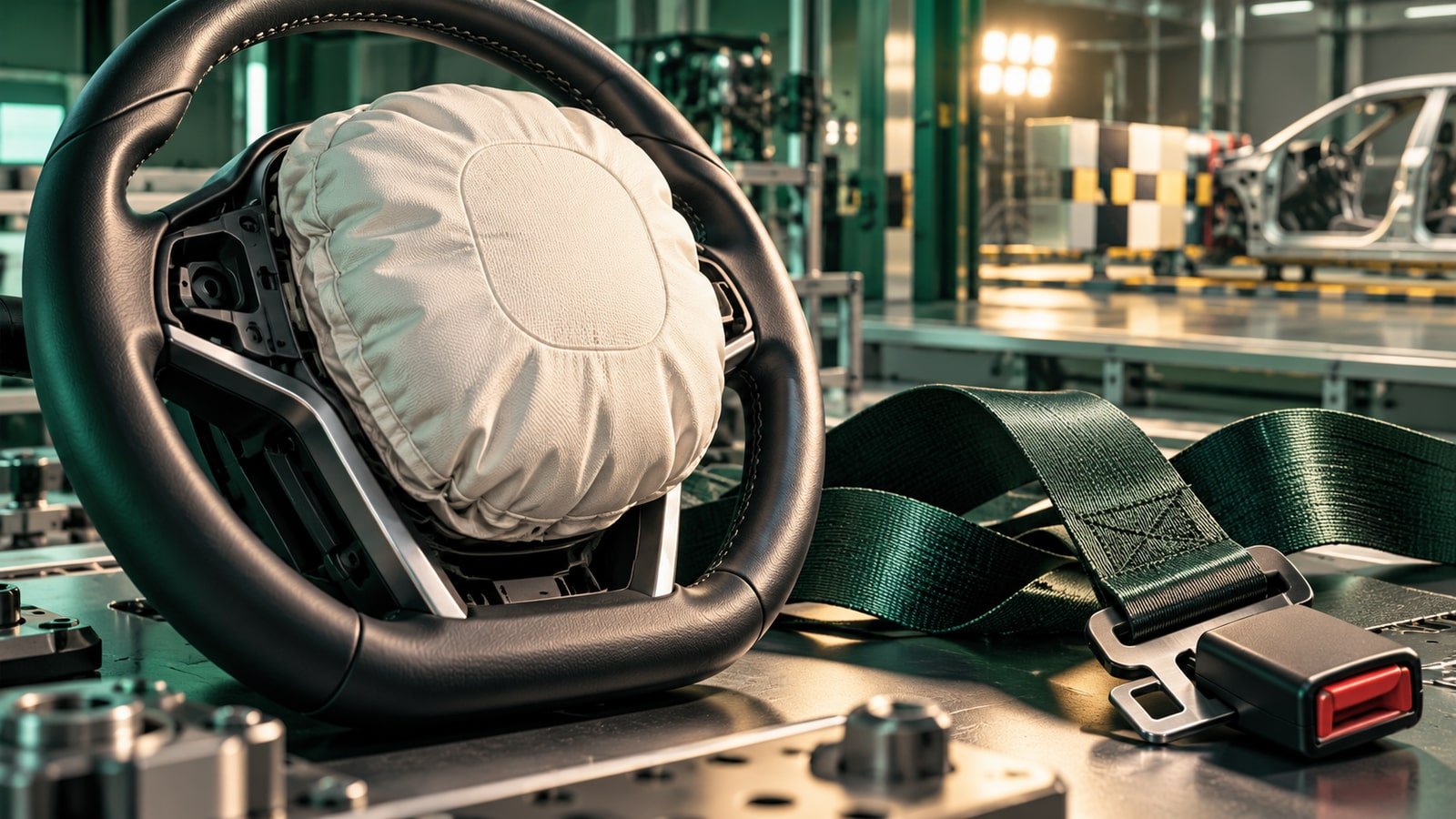
Autoliv narrowed its full-year 2026 adjusted operating-margin forecast to around 10.5%, the lower end of its previous 10.5–11% range. The automotive safety supplier’s third-quarter net sales fell 0.5% to US$2.693 billion.
The Autoliv Q3 2026 results, released on 23 October for the three months ended 30 September, show a modest sales decline alongside lower earnings. Reported diluted earnings per share were US$2.13, while the company’s adjusted measure was US$2.19. Neither figure is a forecast for the share price.
The quarter in comparable figures
| Measure | Q3 2026 | Q3 2025 | Primary source |
|---|---|---|---|
| Net sales | 2,693 | 2,706 | Official record |
| Reported operating income | 254 | 267 | Official record |
| Adjusted operating income | 262 | 271 | Official record |
| Reported diluted EPS | US$2.13 | US$2.28 | Official record |
| Adjusted diluted EPS | US$2.19 | US$2.32 | Official record |
| Operating cash flow | 239 | 258 | Official record |
What changed in the annual outlook?
The change is specific: the expected adjusted operating margin is now around 10.5%, rather than a range extending to 11%. Autoliv retained expectations for approximately unchanged organic sales and around US$1.2 billion in operating cash flow for 2026.
Operating margin describes operating profit as a share of sales. A forecast for that ratio is different from a guarantee of revenue, net profit or cash available to shareholders. The company still has to deliver its remaining-quarter performance.
Why reported and adjusted EPS differ
The full financial report reconciles reported diluted EPS of US$2.13 with adjusted diluted EPS of US$2.19. Its adjustments include capacity-alignment, antitrust-related and associated tax items. Adjusted earnings are a company-defined non-GAAP measure and should be read alongside, not instead of, reported earnings.
Organic sales also differ from reported sales: they remove specified effects such as currency movements. Autoliv reported a 1.1% organic sales decline, compared with the 0.5% decline in total net sales. Those percentages are not interchangeable.
What readers should watch
Autoliv cited higher cost headwinds and expects support from fourth-quarter product launches and raw-material recoveries. These are management’s explanations and expectations, not independently verified future outcomes. A useful follow-up is whether actual margin and operating cash flow reach the stated outlook, rather than whether an adjusted measure alone improves.
For context on another supplier’s reporting, see CapKet’s Volvo Group earnings coverage. The companies and accounting measures differ; this is not a like-for-like valuation comparison.
Sources and scope
This report uses Autoliv’s 23 October results announcement and full quarterly report. Both are from the issuer, not independent corroboration. All comparisons in the table are with Q3 2025. The annual outlook remains forward-looking. No market-price reaction, analyst-consensus comparison or investment recommendation is asserted.
Source observation times
These are the times the official records were checked, not their publication dates.
Recorded source observation: . This is a source-check timestamp, not a market quote or a new article update.